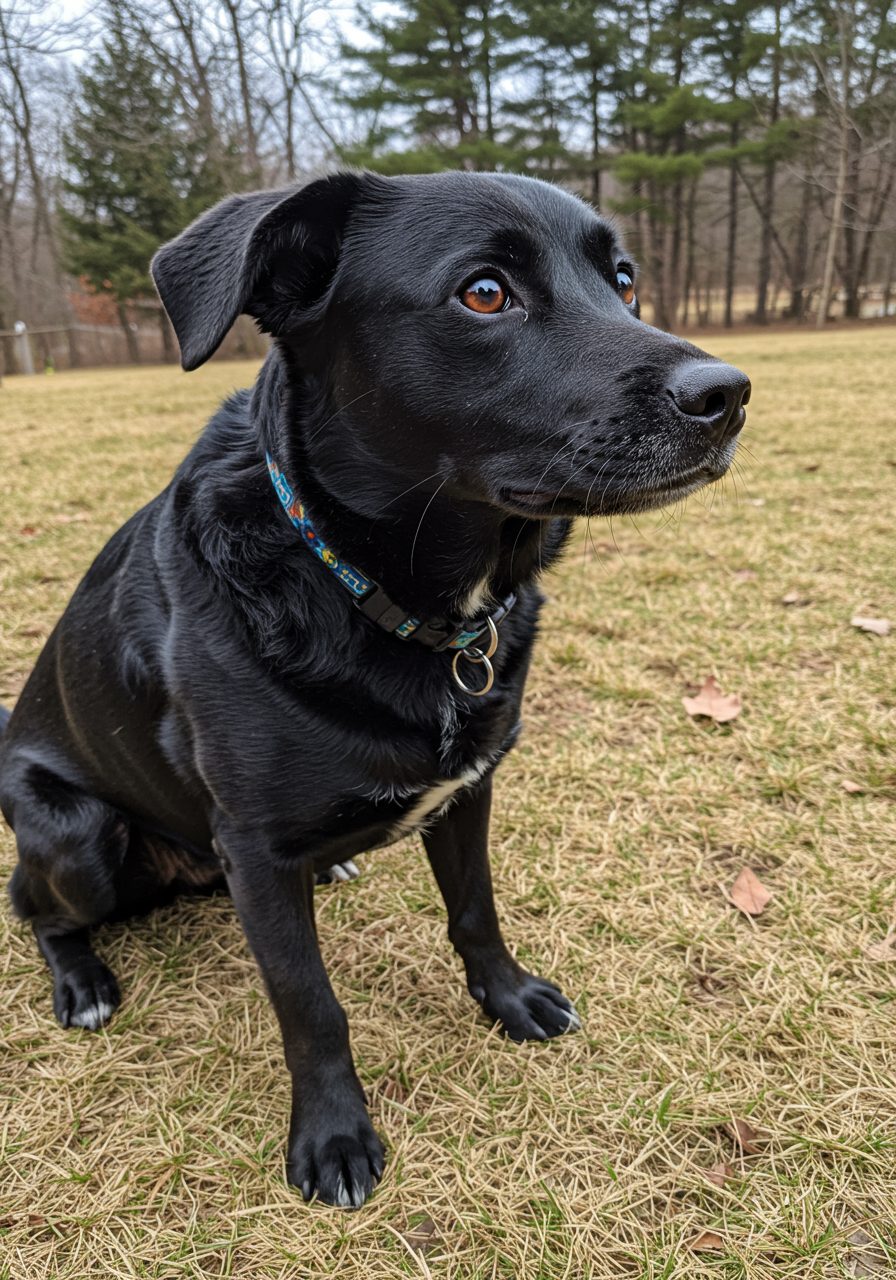
 Training Update: How We Finally Mastered the 'Stay' Command
I. Catchy Introduction
Remember those early days when "stay" was more of a polite suggestion than a command?Yeah, Blackie and I have been there. More like "stay... for a millisecond... then zoom!" It's a memory that still makes me smile, even if at the time it was a source of endless head-scratching.
For Blackie, the world was just too exciting. A squirrel, the doorbell, even just my walking away – poof, his "stay" would evaporate.
He's always been a dog full of life and boundless energy, which is one of the many reasons I love him, but it certainly made training a challenge.
It was cute, in a way, but also a bit nerve-wracking, especially near open doors or when we were out and about.
The thought of him bolting into a busy street or greeting a stranger with an exuberant jump filled me with dread. But guess what? We did it! After a lot of patience, a few re-thinks, and countless high-value treats, Blackie has officially mastered the "Stay" command.
It's a huge milestone for us, one that I honestly wasn't sure we'd ever fully achieve. And today, I'm sharing *how* we finally got there, step-by-step.
This isn't just about teaching a command; it's about building trust, enhancing safety, and strengthening the incredible bond I share with my best boy.
In this post, you'll learn about our struggles, the exact training process we followed, the challenges we faced along the way, and my top tips for helping your own furry friend become a "stay" master too.
II. The "Before" Picture: Our Struggle with "Stay"
Before our breakthrough, "stay" was arguably Blackie's weakest command, which was incredibly frustrating because it's also one of the most vital.I can recall so many instances where his "stay" attempts ended in hilarious, if not slightly maddening, failure.
Specific Examples of "Failed Stays":
- The Door Dash: The minute the doorbell rang, or someone so much as touched the doorknob, Blackie transformed into a furry missile, darting past anyone in his path to "greet" the newcomer. His "stay" was non-existent in the face of such excitement.
- The Treat Snatch: I'd put a treat down and tell him to "stay," planning to make him wait for a few seconds before giving the release word. More often than not, his nose would already be vacuuming up the treat before the word "stay" had even fully left my lips.
- The Walk-Away and Follow: When practicing, if I tried to take more than two steps away from him, he'd be right there at my heels, tail wagging, wondering what fun we were about to have. My attempts to increase distance were met with immediate "follow me" enthusiasm.
- Trying to Get a Photo: Oh, the countless blurry photos of Blackie where he just wouldn't stay still for a second! Forget trying to get that perfect shot of him posing nicely; it was a mission impossible when he just wanted to explore or chew on something.
My own feelings of inadequacy often crept in.
Was I doing something wrong? Was Blackie just too high-energy for this? My patience wore thin sometimes, leading to a bit of frustration on my part, which I'm sure Blackie picked up on.
He wasn't being disobedient intentionally; his excitement and natural doggy instincts simply overwhelmed his ability to focus on the command.
It was a constant battle between his desire to please me and his overwhelming urge to investigate every interesting smell or sound.
Why "Stay" Was So Important to Master:
- Safety: This was paramount. Preventing him from bolting into the street if a door was accidentally left open, or if we were near traffic, was my biggest concern.
- Politeness: Having a dog who can "stay" quietly when guests arrive, rather than jumping all over them, makes for a much more pleasant experience for everyone.
- General Obedience and Control: "Stay" is a foundational command that enables so many other aspects of good behavior, from waiting for food to waiting to be leashed.
- Strengthening Our Bond and Communication: Successfully teaching a difficult command deepens the trust between us. It shows Blackie I can guide him, and it shows me he can learn and rely on my cues.
III. Our Journey to Mastery: Step-by-Step Training Process
Our journey to mastering "stay" wasn't linear, but it was incredibly rewarding.We learned a lot, celebrated small victories, and patiently worked through setbacks.
A. Phase 1: Back to Absolute Basics (The Foundation)
- The "Say It Once" Rule: This was a game-changer. I realized I was often repeating "Blackie, stay! Stay! STAY!" before he even had a chance to process the first command. We implemented a strict "one command, one opportunity" rule. If he broke it, we calmly reset, no scolding, just another attempt.
-
High-Value Rewards (The Motivation): For Blackie, regular kibble just wasn't cutting it for "stay." We switched to what he *really* loved: tiny bits of cheese, cooked chicken, or even a dollop of peanut butter on a spoon.
These rewards were so motivating, they made "stay" the best thing ever. The higher the distraction, the higher the value of the treat. -
Short and Sweet Sessions: We kept training sessions incredibly brief, often just two to five minutes at a time, but multiple times a day.
This prevented boredom and frustration for both of us and kept Blackie engaged and eager for the next session. We always ended on a positive note. -
Controlled Environment: We started in our quietest room, with no television, no other people, no toys, and closed curtains.
Absolute minimal distractions. This allowed Blackie to focus solely on me and the command without external interference. -
The "Release Word" is Key: This was crucial. We picked a consistent, clear release word – "Okay!" – and stuck to it religiously. Blackie learned that he was only allowed to move when he heard "Okay!" not a second before.
This built anticipation and taught him to wait for the explicit instruction. I would even toss the treat *after* he heard the release word and started moving towards it, reinforcing the action sequence. -
Gradually Increasing Duration: Once he understood the concept, we slowly extended the time he had to "stay." We started with one second, then two, then five, and so on.
Crucially, I rewarded him *before* he broke the stay, initially. If he could hold for two seconds, I'd reward at 1.5 seconds. This built confidence. Only after he was solid at a certain duration did I begin to move away. -
Gradually Increasing Distance: After duration was solid at zero distance, I started stepping away. First, one foot, then two, then across the room.
Again, I'd return to him to deliver the treat, rather than calling him to me, to reinforce the idea that "stay" meant staying *in that spot*.
B. Phase 2: Introducing Distractions (The Proofing)
Once Blackie was consistently holding a "stay" for a reasonable duration and distance in a quiet room, it was time to proof the command by introducing distractions.This is where the real test of understanding comes in.
Distraction Progression:
-
Mild Distractions: We started small. I'd move my hands around, jiggle my keys in my pocket, or have another family member calmly walk through the room.
I’d even drop a soft toy (not throw it) to see if he'd hold his stay. If he did, massive praise and jackpot treats! -
Moderate Distractions: Next, we introduced slightly more challenging distractions. I'd play a pre-recorded doorbell sound at a low volume, or we'd practice near a window where someone might walk by outside.
Sometimes, I'd place a highly tempting toy just out of his reach while he was in a "stay" to see if his willpower held.
This phase required a lot of patience and quick intervention if he looked like he was about to break. -
High-Level Distractions: This was the big leagues. We practiced with someone actually ringing the doorbell and coming to the door (with Blackie on a leash initially for safety).
We'd go to a quiet park and practice "stay" with other dogs walking by at a distance, gradually decreasing the distance.
Later, we even practiced in a slightly busier public space.
Crucial Note: If he broke, I calmly reset him in the "stay" position, went back to an easier stage where I knew he could succeed, and praised him for *any* duration he held it.
Never punish. This process is about building positive associations, not fear.
C. Phase 3: Consistency and Generalization (The "A-Ha!" Moments)
This phase was about integrating "stay" into our everyday life, making it a natural part of his routine.Generalization Strategies:
-
Integrating into Daily Life: We started using "stay" before meals (waiting patiently for his food bowl to be put down), before going out the door (waiting for me to open it fully and give the release), and even during grooming sessions (staying still for brushing).
These real-world applications solidified the command's meaning. -
The "Walk-Around" Stay: I started walking a full circle around him while he stayed. This tested his focus on remaining stationary even when I moved around him.
It’s amazing how much more reliable his "stay" became after this practice. -
Long-Distance "Stay": We worked up to practicing where I could go out of sight briefly, stepping into another room for a few seconds before returning to reward him.
This was a true test of his self-control and trust. -
The Unexpected Successes: There was one day, about a month ago, when the doorbell rang loudly, and instinctively, Blackie tensed up. But instead of bolting, he paused, looked at me, and *stayed* in his spot by the couch until I gave him the "Okay!" to go greet the person.
It was a small moment, but it felt like a monumental victory, a true "A-ha!" for both of us.
IV. Challenges We Encountered and How We Overcame Them
Training Blackie was never without its hurdles. He's a smart dog, but also a very lively one!A. Blackie's "Squirrel Brain":
His natural instinct to break for excitement was probably our biggest challenge. A leaf blowing past the window, a distant dog bark, even just me getting up to get a glass of water – these were all potential "stay" breakers.
Solution: We learned that the reward had to be *more* exciting than the distraction. If he loved cheese, and a squirrel was a distraction, then the cheese had to be presented with enthusiasm and immediately after a successful "stay." We also started with extremely minimal distractions and slowly increased them, ensuring success at each step. If he failed, we just went back a step.
B. My Own Impatience/Frustration:
I’ll admit, there were times I wanted too much, too soon. I'd get frustrated when he broke a stay he'd previously held, or when he just wasn't "getting it" as fast as I hoped.
Solution: Short, positive sessions were key. We learned to celebrate tiny victories – a one-second "stay" was just as worthy of praise as a ten-second one in the beginning. I also reminded myself that it's a marathon, not a sprint, and that every dog learns at their own pace. Consistency, not speed, was our goal.
C. The "Broken Stay" Dilemma:
What to do when he simply broke the command? My initial instinct might have been to scold or show disappointment.
Solution: No punishment, ever! If Blackie broke his stay, I would calmly walk him back to his original spot, put him back into the "stay" position, and make the command easier – perhaps by standing closer or asking for a shorter duration. The goal was to set him up for success in the next attempt and praise even the smallest effort.
D. Finding the Right Motivation:
There were moments when even high-value treats seemed to lose their sparkle, especially in high-distraction environments.
Solution: We had to get creative. Sometimes, a quick game of tug-of-war after a good stay was more motivating than a treat. Other times, it was enthusiastic verbal praise and a good ear scratch. I learned to experiment and use a variety of rewards, understanding that motivation isn't a one-size-fits-all approach.
V. Life with a "Stay" Master: The Benefits and Beyond
Life with Blackie since he’s mastered the "stay" command has transformed in so many wonderful ways.A. Enhanced Safety:
This is by far the biggest benefit. The peace of mind I have near roads, open doors, or when unexpected visitors arrive is invaluable. I know I can rely on him to stay put when it truly matters.
B. Improved Manners:
Greeting guests calmly, waiting for his food, and not bolting out of the car or house when a door opens are all direct results of a solid "stay." He’s become a much more polite and well-mannered companion.
C. More Enjoyable Outings:
Walks are more relaxed, less pulling, and I can trust him to stay by my side if I need to stop and talk to someone or tie my shoe. It's truly liberating.
D. Stronger Bond:
Through this training journey, our communication has become clearer, and our mutual trust has deepened. He understands what I'm asking, and I understand his capabilities and limits. It's a wonderful feeling of partnership.
E. "Trick" Foundations:
"Stay" is the foundation for so many other tricks and commands. "Wait," "down," "place," and even fun tricks like "take a bow" all rely on a solid "stay" understanding.
F. Our Current "Stay" Status:
Blackie can now hold a stay for five minutes or more, even when I leave the room and go out of sight. He can also hold a stay with moderate distractions like the doorbell ringing or people walking past our house. It’s truly amazing to see his progress!
VI. My Top Tips for Fellow Dog Owners
If you're currently in the trenches of "stay" training, here are my best pieces of advice:A. Start Simple, Build Slowly:
Don't rush it. Success breeds success. Master the basics in a distraction-free environment before moving on.
B. Consistency is Key:
Practice every day, even if it's just for a minute or two. Short, frequent sessions are more effective than long, infrequent ones.
C. Reward Generously (Especially at First):
Make "stay" the best thing ever for your dog. Use the highest value treats and enthusiastic praise.
D. Always Use a Clear Release Word:
This teaches them when they *can* move and reinforces the concept of waiting for your signal.
E. Proof, Proof, Proof:
Practice in different places with different distractions. This generalizes the command so your dog understands it applies everywhere.
F. Keep it Fun and Positive:
Always end on a good note. If your dog is getting frustrated, make the task easier and end with a success. Training should be a bonding experience, not a chore.
G. Don't Get Discouraged by Setbacks:
Every dog, and every owner, has off days. Progress isn't always a straight line. Just calmly reset and try again.
H. Consider Professional Help if Stuck:
If you're truly struggling, a good certified dog trainer can offer personalized advice and help you troubleshoot specific issues. It's an investment that pays off!
VII. Conclusion and Call to Action
From a chaotic dash to a calm, controlled wait, Blackie's journey to mastering "stay" has been an incredible one.It's a testament to patience, positive reinforcement, and the incredible capacity of our canine companions to learn and grow.
If we can do it, you can too! Every dog is capable of learning, and every training step, no matter how small, strengthens the incredible bond you share.
Training Blackie has taught me so much, not just about dog behavior, but also about perseverance and celebrating progress.
It's truly deepened our connection, making us an even stronger team. What command are you currently working on with your pup? Share your biggest training challenge or a recent success story in the comments below! I'd love to hear your own "stay" tips and tricks too.
Comments
Post a Comment